Question 8
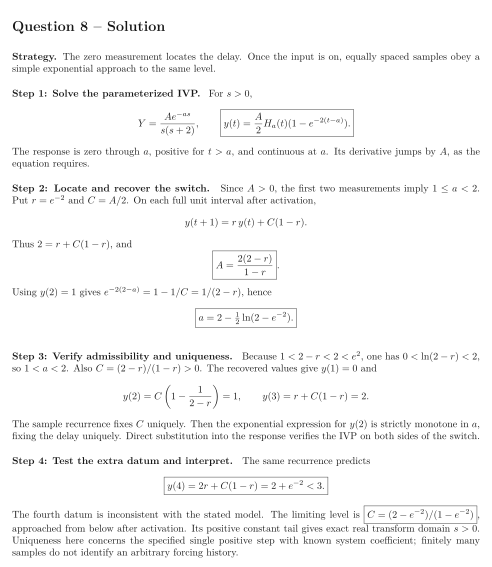
Let for and for . Use one-sided Laplace transforms. Solutions are continuous (and have continuous first derivative for second-order equations); satisfy the equation away from switches and use one-sided derivatives there. Isolated input values do not change the solution.
An initially unexcited system is driven by one unknown positive step: Exact measurements give , , and . A fourth proposed measurement is .
Tasks
Derive the transformed and time-domain response for arbitrary .
Use positivity and the measurements to locate the switch interval, then determine and exactly.
Verify that the recovered parameters satisfy all three original measurements and are unique in this one-step family.
Test the fourth measurement and find the limiting response. Explain the scope of the identification.
Show solutionHide solution
Question 8 – Solution
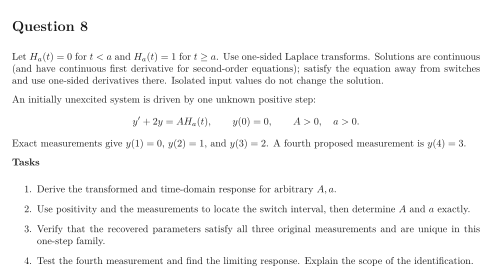
Strategy. The zero measurement locates the delay. Once the input is on, equally spaced samples obey a simple exponential approach to the same level.
Step 1: Solve the parameterized IVP. For , The response is zero through , positive for , and continuous at . Its derivative jumps by , as the equation requires.
Step 2: Locate and recover the switch. Since , the first two measurements imply . Put and . On each full unit interval after activation, Thus , and Using gives , hence
Step 3: Verify admissibility and uniqueness. Because , one has , so . Also . The recovered values give and The sample recurrence fixes uniquely. Then the exponential expression for is strictly monotone in , fixing the delay uniquely. Direct substitution into the response verifies the IVP on both sides of the switch.
Step 4: Test the extra datum and interpret. The same recurrence predicts The fourth datum is inconsistent with the stated model. The limiting level is , approached from below after activation. Its positive constant tail gives exact real transform domain . Uniqueness here concerns the specified single positive step with known system coefficient; finitely many samples do not identify an arbitrary forcing history.