Question 5
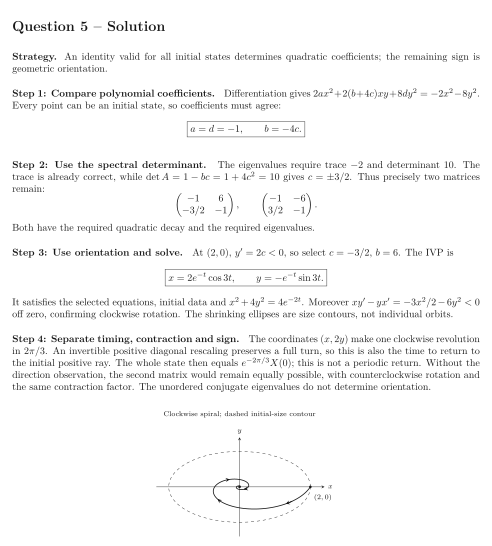
An unknown real matrix has eigenvalues . Every solution of satisfies At the state , the velocity has a negative second component. Use all three observations to reconstruct the system.
Tasks
Write and extract the restrictions imposed by the quadratic identity at arbitrary states.
Use the eigenvalues to find every matrix consistent with that identity before applying the direction observation.
Select the correct matrix and solve the IVP starting at . Verify its quadratic size and rotation direction.
Find the time and contraction factor for one complete turn. Explain precisely which ambiguity would remain if the direction observation were omitted.
Show solutionHide solution
Question 5 – Solution
Strategy. An identity valid for all initial states determines quadratic coefficients; the remaining sign is geometric orientation.
Step 1: Compare polynomial coefficients. Differentiation gives . Every point can be an initial state, so coefficients must agree:
Step 2: Use the spectral determinant. The eigenvalues require trace and determinant . The trace is already correct, while gives . Thus precisely two matrices remain: Both have the required quadratic decay and the required eigenvalues.
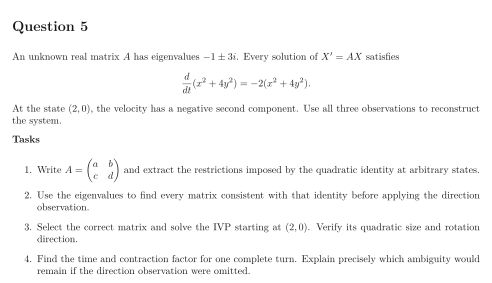
Step 3: Use orientation and solve. At , , so select , . The IVP is It satisfies the selected equations, initial data and . Moreover off zero, confirming clockwise rotation. The shrinking ellipses are size contours, not individual orbits.
Step 4: Separate timing, contraction and sign. The coordinates make one clockwise revolution in . An invertible positive diagonal rescaling preserves a full turn, so this is also the time to return to the initial positive ray. The whole state then equals ; this is not a periodic return. Without the direction observation, the second matrix would remain equally possible, with counterclockwise rotation and the same contraction factor. The unordered conjugate eigenvalues do not determine orientation.
See the diagram in the original worksheet below.