Question 3
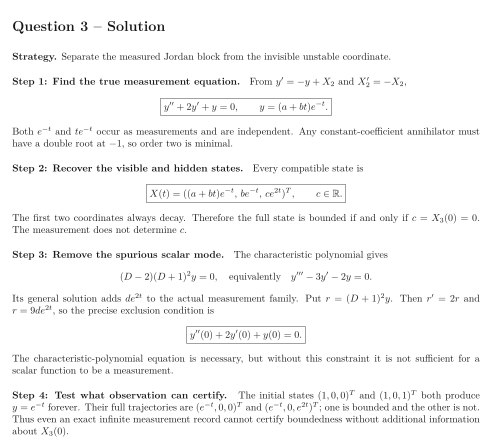
Only one coordinate of the following system is observed: A proposed scalar model is obtained by replacing the characteristic polynomial of with a differential operator.
Tasks
Derive the lowest-order monic constant-coefficient homogeneous scalar equation satisfied by every possible measurement . Prove that this order is minimal.
For a prescribed measurement, reconstruct all compatible states. Determine exactly which initial states are bounded on .
Write the third-order scalar equation suggested by the characteristic polynomial. Identify its extra scalar mode, and find the initial constraint that excludes that mode.
Decide whether an arbitrarily long, exact record of can certify boundedness of the full state. Exhibit two states with identical measurements and different boundedness behavior.
Show solutionHide solution
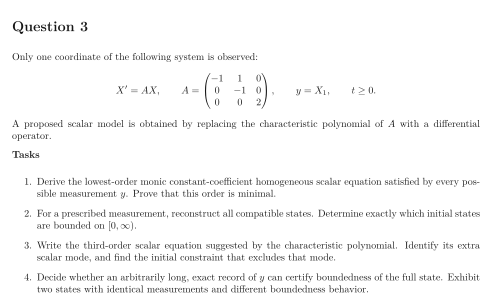
Question 3 – Solution
Strategy. Separate the measured Jordan block from the invisible unstable coordinate.
Step 1: Find the true measurement equation. From and , Both and occur as measurements and are independent. Any constant-coefficient annihilator must have a double root at , so order two is minimal.
Step 2: Recover the visible and hidden states. Every compatible state is The first two coordinates always decay. Therefore the full state is bounded if and only if . The measurement does not determine .
Step 3: Remove the spurious scalar mode. The characteristic polynomial gives Its general solution adds to the actual measurement family. Put . Then and , so the precise exclusion condition is The characteristic-polynomial equation is necessary, but without this constraint it is not sufficient for a scalar function to be a measurement.
Step 4: Test what observation can certify. The initial states and both produce forever. Their full trajectories are and ; one is bounded and the other is not. Thus even an exact infinite measurement record cannot certify boundedness without additional information about .