Question 3
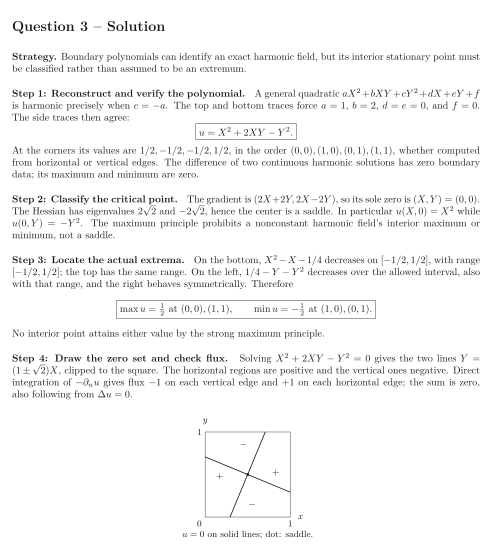
Use centered coordinates , on the unit square. A harmonic temperature has the following boundary data: Seek a harmonic polynomial of degree at most two.
Tasks
Recover the polynomial from the four traces. Check their corner compatibility and prove uniqueness among all continuous harmonic solutions.
Find and classify every interior critical point. Explain why its existence does not contradict the maximum principle.
Find the exact global maximum and minimum on the closed square and all points where they occur.
Draw the zero-temperature lines and label the signs of the regions they separate. Verify that the total outward conductive flux, with conductivity one, is zero.
Show solutionHide solution
Question 3 – Solution
Strategy. Boundary polynomials can identify an exact harmonic field, but its interior stationary point must be classified rather than assumed to be an extremum.
Step 1: Reconstruct and verify the polynomial. A general quadratic is harmonic precisely when . The top and bottom traces force , , , and . The side traces then agree: At the corners its values are , in the order , whether computed from horizontal or vertical edges. The difference of two continuous harmonic solutions has zero boundary data; its maximum and minimum are zero.
Step 2: Classify the critical point. The gradient is , so its sole zero is . The Hessian has eigenvalues and , hence the center is a saddle. In particular while . The maximum principle prohibits a nonconstant harmonic field’s interior maximum or minimum, not a saddle.
Step 3: Locate the actual extrema. On the bottom, decreases on , with range ; the top has the same range. On the left, decreases over the allowed interval, also with that range, and the right behaves symmetrically. Therefore No interior point attains either value by the strong maximum principle.
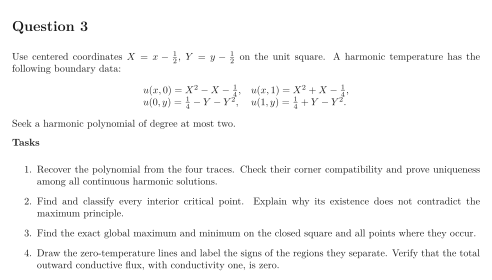
Step 4: Draw the zero set and check flux. Solving gives the two lines , clipped to the square. The horizontal regions are positive and the vertical ones negative. Direct integration of gives flux on each vertical edge and on each horizontal edge; the sum is zero, also following from .
See the diagram in the original worksheet below.