Question 3
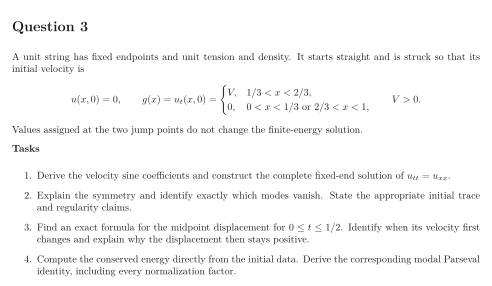
A unit string has fixed endpoints and unit tension and density. It starts straight and is struck so that its initial velocity is Values assigned at the two jump points do not change the finite-energy solution.
Tasks
Derive the velocity sine coefficients and construct the complete fixed-end solution of .
Explain the symmetry and identify exactly which modes vanish. State the appropriate initial trace and regularity claims.
Find an exact formula for the midpoint displacement for . Identify when its velocity first changes and explain why the displacement then stays positive.
Compute the conserved energy directly from the initial data. Derive the corresponding modal Parseval identity, including every normalization factor.
Show solutionHide solution
Question 3 – Solution
Strategy. A velocity profile must be integrated in time; its jumps do not permit a globally classical interpretation of the initial state.
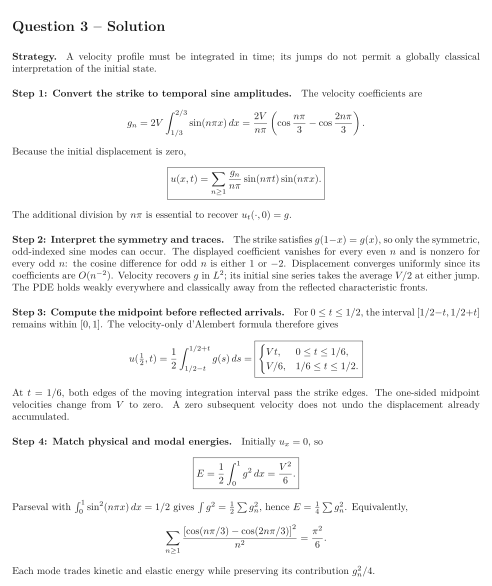
Step 1: Convert the strike to temporal sine amplitudes. The velocity coefficients are Because the initial displacement is zero, The additional division by is essential to recover .
Step 2: Interpret the symmetry and traces. The strike satisfies , so only the symmetric, odd-indexed sine modes can occur. The displayed coefficient vanishes for every even and is nonzero for every odd : the cosine difference for odd is either or . Displacement converges uniformly since its coefficients are . Velocity recovers in ; its initial sine series takes the average at either jump. The PDE holds weakly everywhere and classically away from the reflected characteristic fronts.
Step 3: Compute the midpoint before reflected arrivals. For , the interval remains within . The velocity-only d’Alembert formula therefore gives At , both edges of the moving integration interval pass the strike edges. The one-sided midpoint velocities change from to zero. A zero subsequent velocity does not undo the displacement already accumulated.
Step 4: Match physical and modal energies. Initially , so Parseval with gives , hence . Equivalently, Each mode trades kinetic and elastic energy while preserving its contribution .